
Basic: SOI
The simplest EMode simulation example.
This code example is licensed under the BSD 3-Clause License.
import emodeconnection as emc

## Set simulation parameters
wavelength = 1550 # [nm] wavelength
dx, dy = 10, 10 # [nm] resolution
w_core = 600 # [nm] waveguide core width
w_trench = 800 # [nm] waveguide side trench width
h_core = 500 # [nm] waveguide core height
h_clad = 800 # [nm] waveguide top and bottom clad
num_modes = 2 # [-] number of modes

## Connect and initialize EMode
em = emc.EMode()

## Settings
em.settings(
    wavelength = wavelength, x_resolution = dx, y_resolution = dy,
    window_width = w_core + w_trench*2, window_height = h_core + h_clad*2,
    num_modes = num_modes, background_material = 'Air')

## Draw shapes
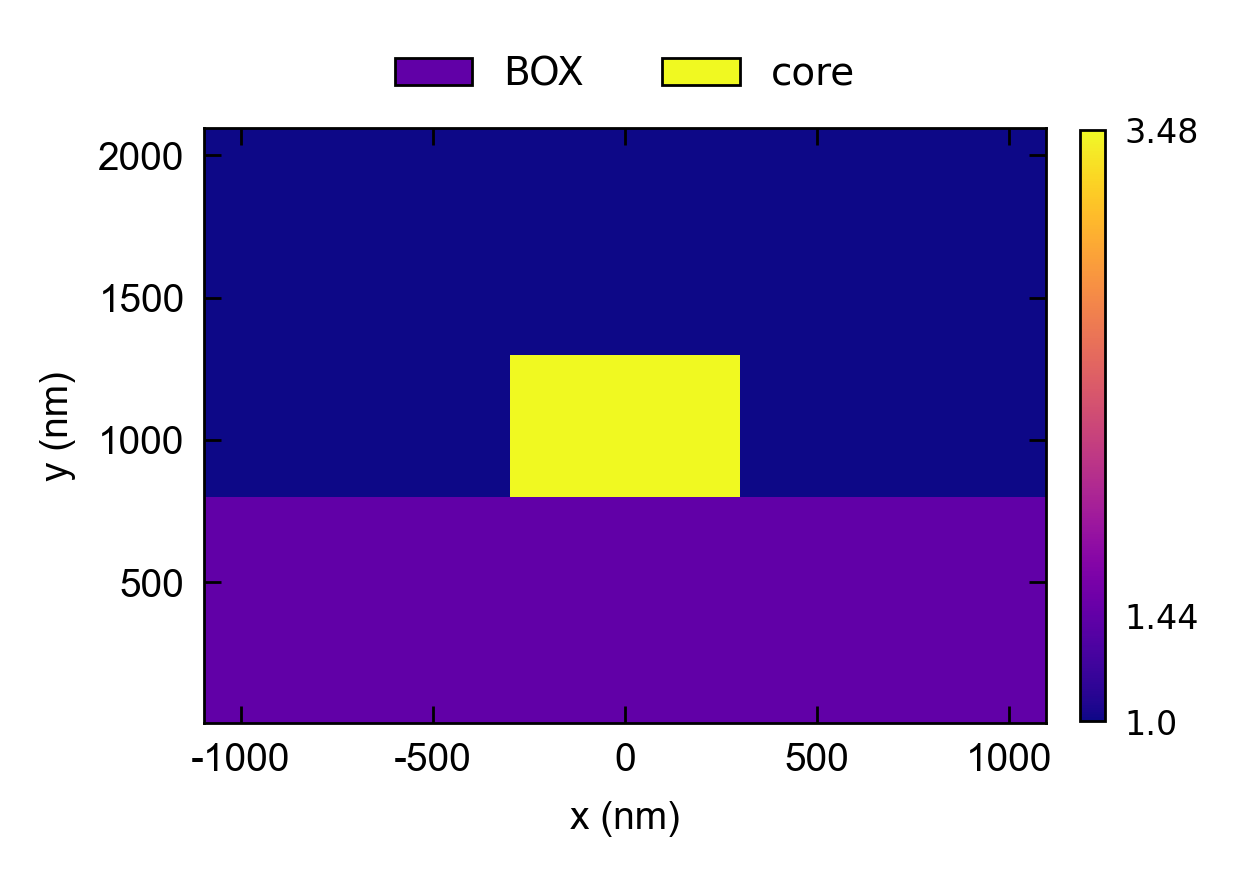
em.shape(name = 'BOX', material = 'SiO2', height = h_clad)
em.shape(name = 'core', material = 'Si', width = w_core, height = h_core)

## Launch FDM solver
em.FDM()

## Display the effective indices, TE fractions, and core confinement
em.report()

## Plot the field and refractive index profiles
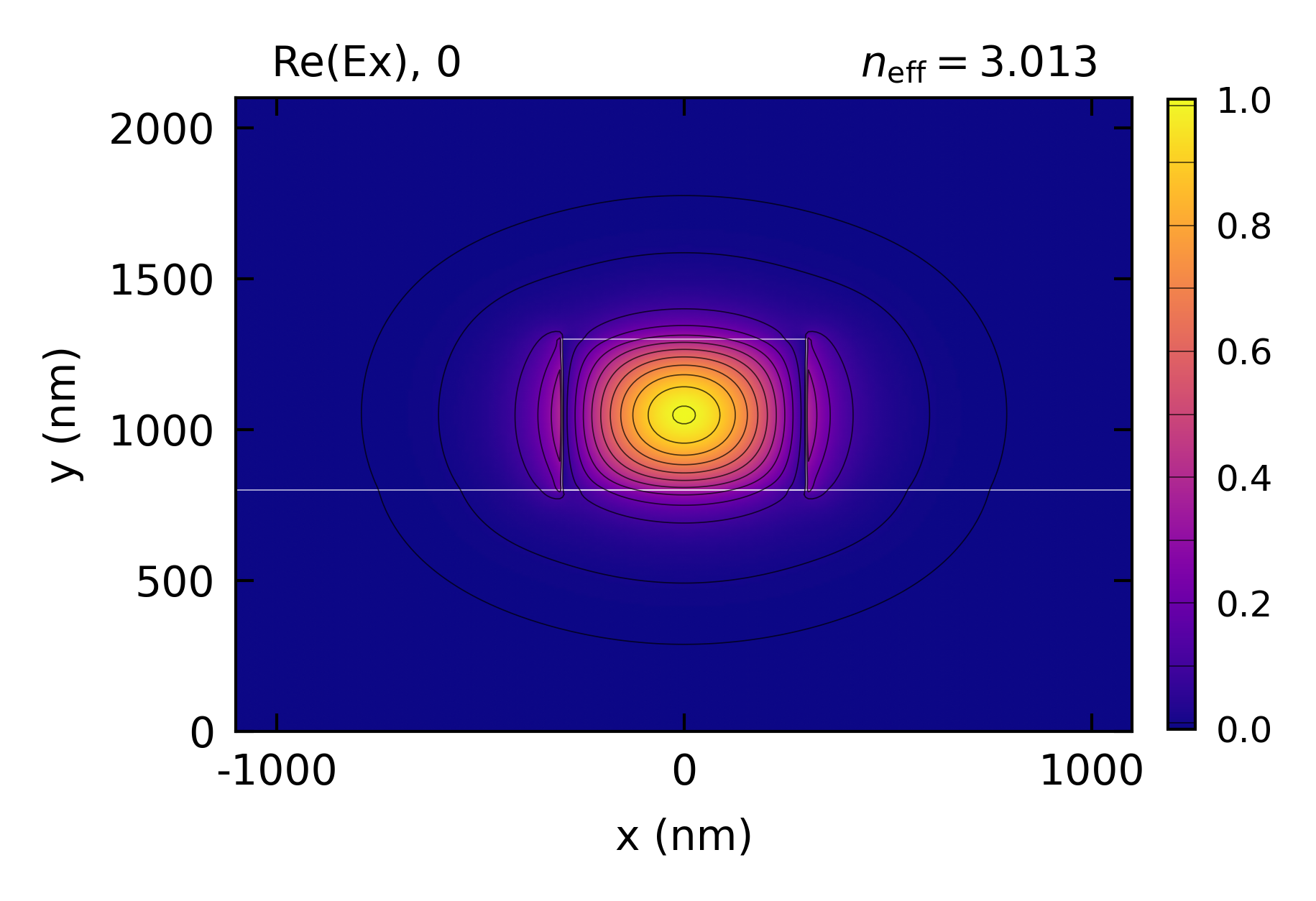
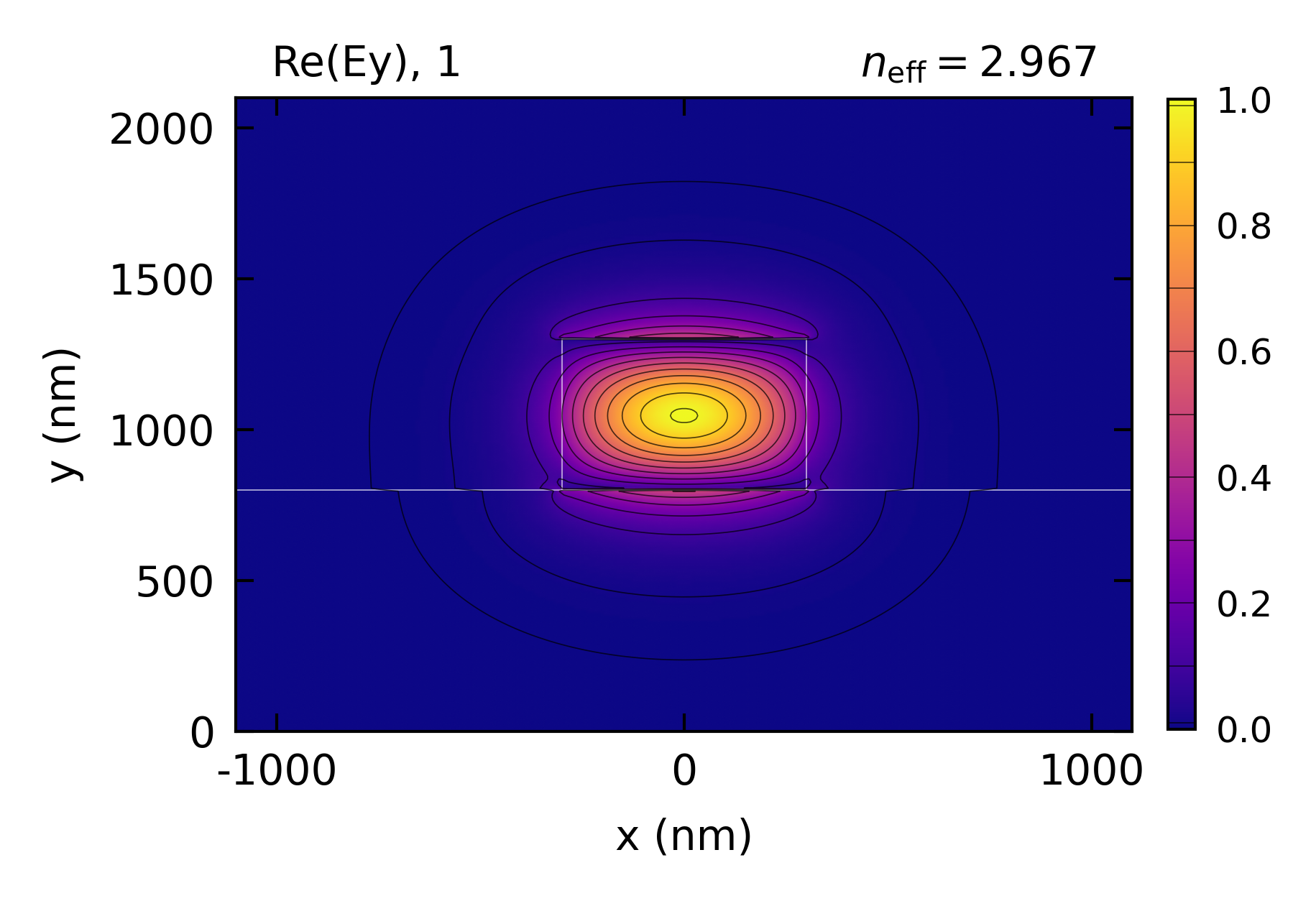
em.plot()

## Close EMode
em.close()
Console output:
EMode3D 1.0.6 - email
Meshing completed in 0.6 sec
Solving modes completed in 1.5 sec

Wavelength: 1550.0 nm    Solver: FDM

  Mode #     n_eff    TE %    Loss (dB/m)
--------  --------  ------  -------------
    TE-0  3.013224  99.6 %          0.000
    TM-1  2.966573   0.6 %          0.000

Exited EMode
Figures: