
EME: Angled Facet
Coupling a lensed-fiber Gaussian beam through a tapered, angled-facet output, and how much an angled facet suppresses back-reflection.
This code example is licensed under the BSD 3-Clause License.
import sys
import numpy as np
import emodeconnection as emc
from emodeconnection import make_angled_facet_port
from matplotlib import pyplot as plt

## Set simulation parameters
wavelength = 780  # [nm] wavelength
dx, dy = 20, 20  # [nm] resolution
h_core = 300  # [nm] waveguide core height (SiN)
clad = 1000  # [nm] waveguide cladding (SiO2)
w_narrow = 1200  # [nm] narrow (input) waveguide width
w_wide = 3000  # [nm] wide (facet) waveguide width
window_width = w_wide + clad * 2  # [nm]
window_height = h_core + clad * 2  # [nm]
core_center = (0, window_height / 2)  # [nm]
num_modes = 10  # [-]
BC = '00'

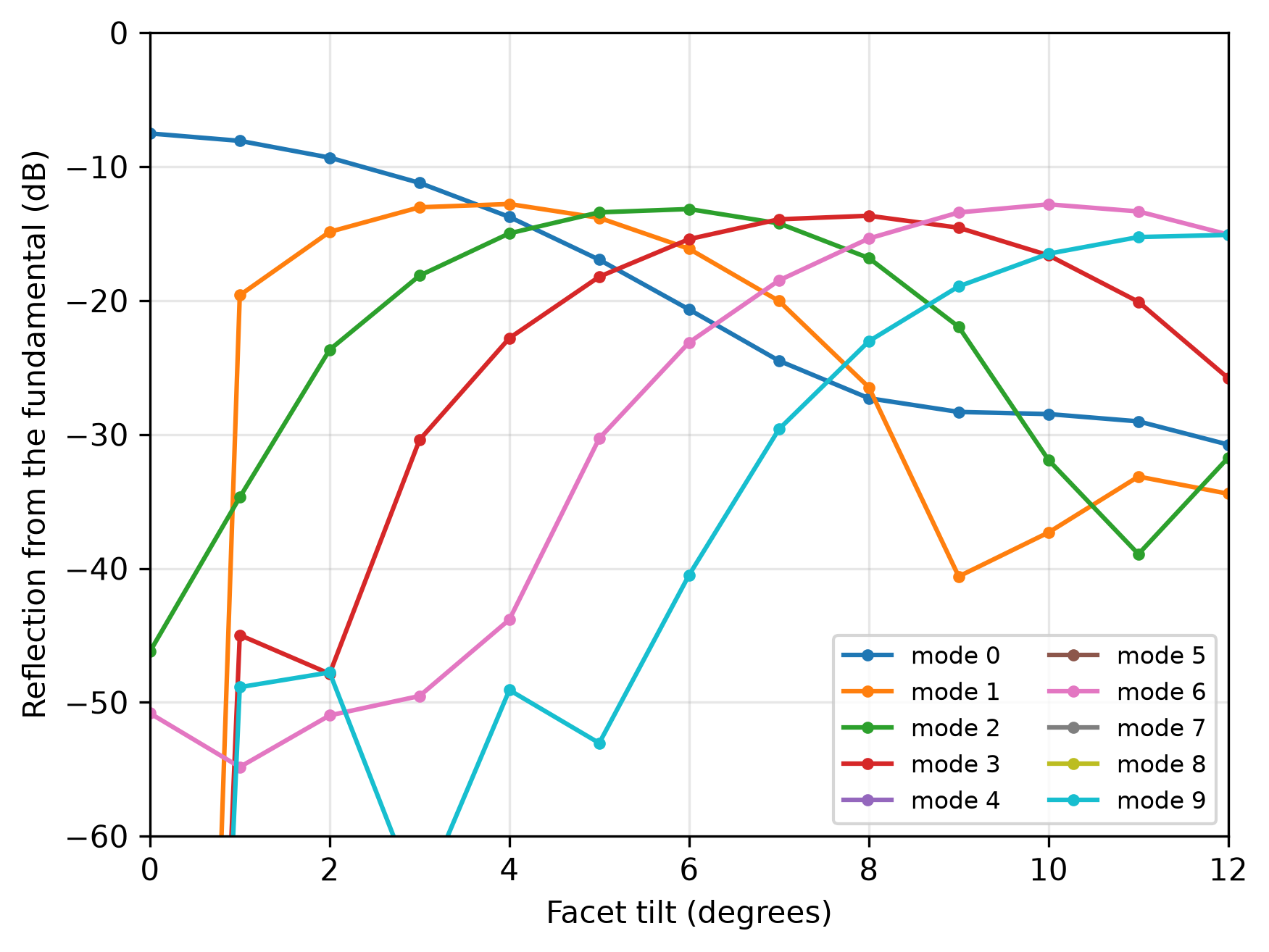
## Part 1: Tilting the facet throws the reflection
## into higher order modes, so the fundamental mode
## reflection falls sharply with angle.
em = emc.EMode(emode_cmd=sys.argv[1:], simulation_name='facet_sweep')

em.settings(
    wavelength=wavelength, x_resolution=dx, y_resolution=dy,
    window_width=window_width, window_height=window_height,
    num_modes=num_modes, boundary_condition=BC,
    background_material='SiO2')

em.shape(name='BOX', material='SiO2', height=clad)
em.shape(name='core', material='Ta2O5', height=h_core, etch_depth=h_core, mask=w_wide)
em.label_profile(name='wide')

## The facet re-references the waveguide's right-hand port to a tilted plane.
## Renaming it from 'right' to 'out' must be carried into connect_ports.
em.straight_section(
    name='wg', profile='wide', length=2e3,
    ports=[make_angled_facet_port('out', 'right', pivot_angle=0)])

em.pwd_section(
    name='gap', length=1e3, material='Air',
    window=(window_width * 2, window_height * 2),
    offset=core_center, num_modes=1024)

em.connect_ports(pairs=[('wg.out', 'gap.left')])

## Sweep the facet tilt and keep the S-matrix at each angle.
tilts = np.arange(0, 12.1, 1)  # [deg]
data = em.sweep(key='section, wg, facet_angle', values=tilts, result='S_matrix')

## Reflection from the fundamental into every guided mode: the tilt steers power
## into the higher-order modes. R + T is printed as a check that the modal basis is large enough.
reflection = np.array([np.abs(s.reflection(0))[:num_modes, 0] ** 2
                       for s in data['S_matrix']])
for tilt, s in zip(tilts, data['S_matrix']):
    budget = (np.abs(s.reflection(0))[:, 0] ** 2).sum() + \
             (np.abs(s.transmission(0, 1))[:, 0] ** 2).sum()
    print(f'tilt {tilt:4.1f} deg: R + T = {budget * 100:5.1f} %')

for m in range(num_modes):
    plt.plot(tilts, 10*np.log10(reflection[:, m]), marker='o', ms=3, label=f'mode {m}')
plt.xlabel('Facet tilt (degrees)')
plt.ylabel('Reflection from the fundamental (dB)')
# plt.yscale('log')
plt.ylim(top=0, bottom=-60)
plt.autoscale(enable=True, axis='x', tight=True)
plt.legend(fontsize=8, ncol=2)
plt.grid(True, which='both', alpha=0.3)
plt.savefig('facet_reflection_vs_tilt.png', dpi=300, bbox_inches='tight')

em.close()

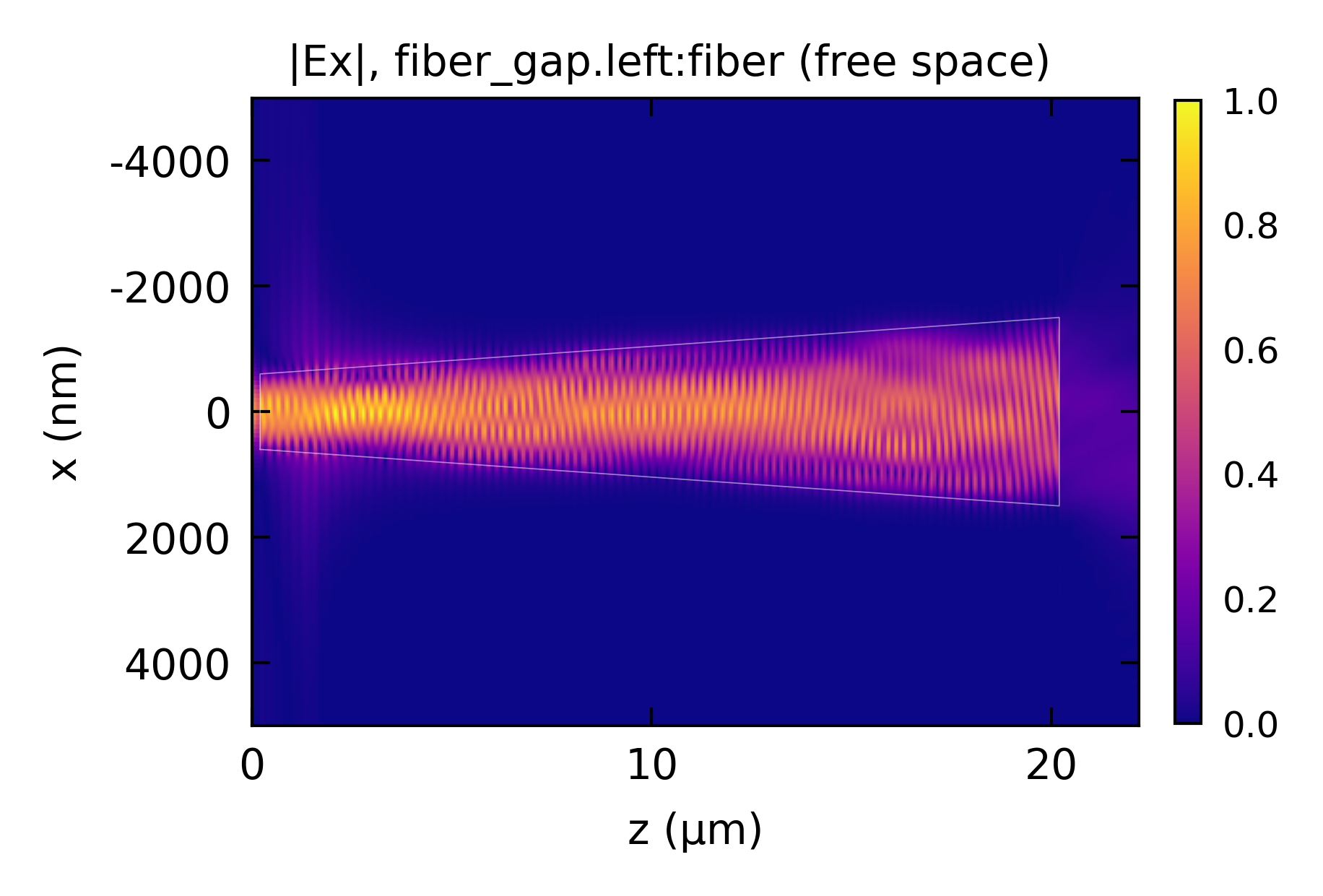
## Part 2: a lensed fiber coupling in, through an adiabatic taper to an angled
## output facet. A free-space field launches a Gaussian beam at the input.
em2 = emc.EMode(emode_cmd=sys.argv[1:], simulation_name='facet_coupling')

em2.settings(
    wavelength=wavelength, x_resolution=dx, y_resolution=dy,
    window_width=window_width*2, window_height=window_height,
    num_modes=num_modes, boundary_condition=BC,
    background_material='SiO2')

em2.shape(name='BOX', material='SiO2', height=clad)
em2.shape(name='core', material='Ta2O5', height=h_core, etch_depth=h_core, mask=w_narrow)
em2.label_profile(name='narrow')
em2.shape(name='core', mask=w_wide)
em2.label_profile(name='wide')

em2.pwd_section(
    name='fiber_gap', length=200, material='Air',
    window=(window_width * 2, window_height * 2), offset=core_center, num_modes=1024)

em2.taper_section(
    name='taper', profile='narrow', profile_end='wide', length=20e3,
    ports=[make_angled_facet_port('out', 'right', pivot_angle=10)])

em2.pwd_section(
    name='out_gap', length=2e3, material='Air',
    window=(window_width * 2, window_height * 2),
    offset=core_center, num_modes=1024)

em2.connect_ports(pairs=[('taper.out', 'out_gap.left')])

## gaussian_field takes the field 1/e radius, which is the intensity FWHM
## divided by sqrt(2 ln 2)
fwhm = 600  # [nm]
waist = fwhm / np.sqrt(2 * np.log(2))

em2.free_space_field(
    name='fiber', port='fiber_gap.left',
    # name='fiber', port='left',
    waist=waist, center=core_center, wavelength=wavelength)

em2.EME()

## How much of the beam's power the input port's modes capture; the rest radiates
## away uncoupled and is not in the S-matrix.
report = em2.free_space_field_diagnostics(name='fiber')
print(report)

## 'section' scales each section by its own peak, so the beam spreading in
## the free-space gaps stays visible next to the much brighter guided mode
em2.plot(
    excitation='fiber', component='Ex', plot_function='abs', plane='z-x',
    normalization='section')

## Close EMode
em2.close()
Console output:
EMode3D 1.0.6 - email

Sweeping section parameter 'facet_angle'...
Solving EME: facet_angle = 0.0... completed in 10.4 sec
Solving EME: facet_angle = 1.0... completed in 9.1 sec
Solving EME: facet_angle = 2.0... completed in 9.1 sec
Solving EME: facet_angle = 3.0... completed in 9.1 sec
Solving EME: facet_angle = 4.0... completed in 9.2 sec
Solving EME: facet_angle = 5.0... completed in 9.1 sec
Solving EME: facet_angle = 6.0... completed in 9.0 sec
Solving EME: facet_angle = 7.0... completed in 8.9 sec
Solving EME: facet_angle = 8.0... completed in 9.1 sec
Solving EME: facet_angle = 9.0... completed in 9.0 sec
Solving EME: facet_angle = 10.0... completed in 8.9 sec
Solving EME: facet_angle = 11.0... completed in 9.1 sec
Solving EME: facet_angle = 12.0... completed in 9.1 sec
 completed in 1 min 59.2 sec
Exited EMode
EMode3D 1.0.6 - email

Solving S-matrices...
Solving section: fiber_gap... completed in 0.0 sec
Solving section: taper... completed in 2 min 27.2 sec
Solving section: out_gap... completed in 0.0 sec
 completed in 2 min 27.2 sec
Exited EMode
tilt  0.0 deg: R + T =  96.0 %
tilt  1.0 deg: R + T =  93.3 %
tilt  2.0 deg: R + T =  89.7 %
tilt  3.0 deg: R + T =  86.3 %
tilt  4.0 deg: R + T =  83.3 %
tilt  5.0 deg: R + T =  80.6 %
tilt  6.0 deg: R + T =  78.2 %
tilt  7.0 deg: R + T =  76.5 %
tilt  8.0 deg: R + T =  75.6 %
tilt  9.0 deg: R + T =  74.9 %
tilt 10.0 deg: R + T =  71.6 %
tilt 11.0 deg: R + T =  62.3 %
tilt 12.0 deg: R + T =  46.6 %
free-space field 'fiber' at port 'fiber_gap.left' (780 nm): 100.0% captured by a 1022-mode basis
Figures: