
Straight Waveguide Convergence
The SiN guide of Bend Mode Solvers (2000 x 200 nm SiN in SiO2 at 980 nm), straight
and with no PML, solved by the FDM and the FEM to show how fast each converges and what a converged
answer costs. The FDM is solved on a series of grids, over the full window and folded by
boundary_condition='TE', and the FEM on the fixed meshes of the bend example
(fem_max_refinements=0). Each solve’s effective index and group index are compared against the
finest FEM mesh.
The field has decayed to almost nothing at the walls, so the only error left is the mesh’s. The same guide with a bend and a PML is in Bend Mode Solvers, and the two pages compare directly.
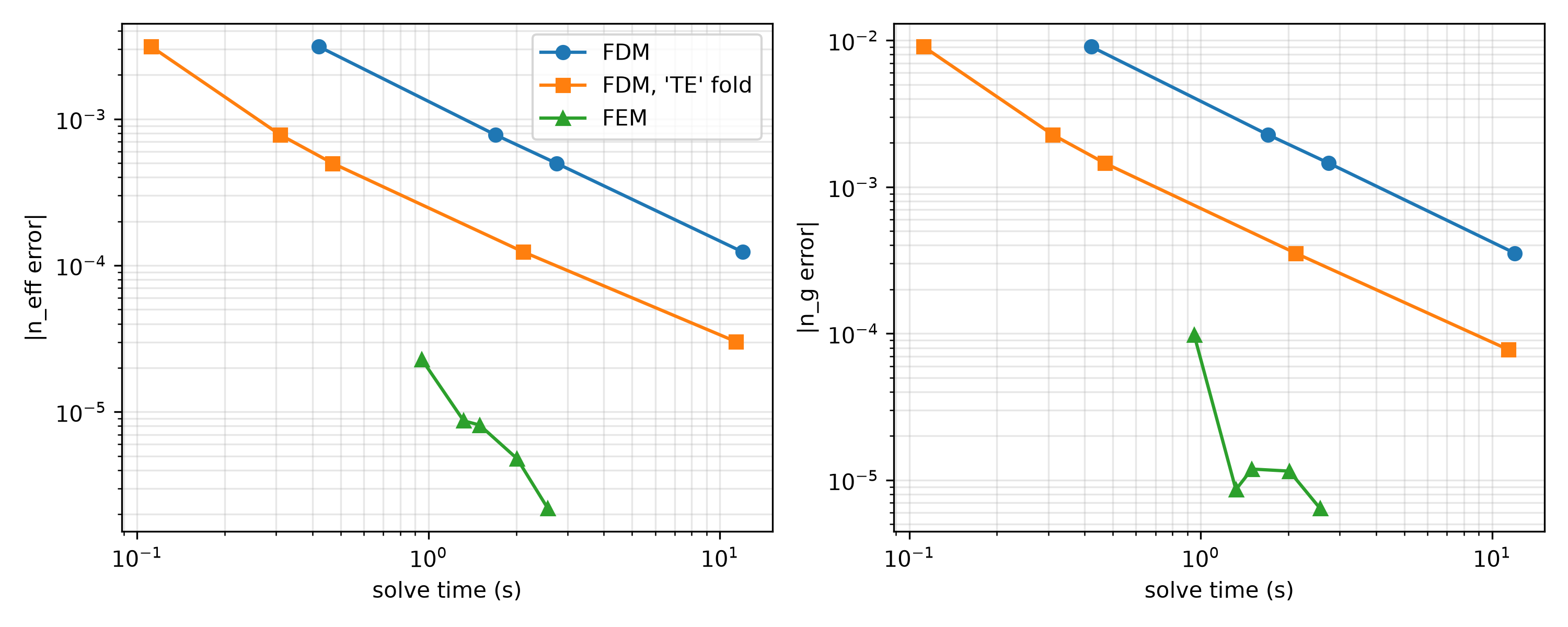
The FDM converges at second order: halving the grid spacing cuts the error by four. Its group index converges at the same order with a larger error, so it needs a finer grid than the effective index. Folding the window gives the same answer several times faster.
The FEM is the better method for accuracy per second, but it requires EMode3D. Even its fastest solve is closer to the converged effective index than the FDM’s finest grid, and every FEM mesh gives an accurate group index. A Richardson extrapolation of the folded FDM results independently confirms the FEM reference.
This code example is licensed under the BSD 3-Clause License.
import sys
import time
import numpy as np
import emodeconnection as emc
from matplotlib import pyplot as plt

## Set simulation parameters: the SiN guide of the 'Bend Mode Solvers' example, straight
wavelength = 980  # [nm] wavelength
w_core = 2000  # [nm] waveguide core width
w_trench = 2500  # [nm] cladding beside the core
h_core = 200  # [nm] waveguide core height
h_clad = 2000  # [nm] cladding above and below the core
window_width = w_core + w_trench*2  # [nm]
window_height = h_core + h_clad*2  # [nm]

## The FDM grids all put the core's edges on grid lines (each divides 100 nm),
## and the FEM meshes are fixed (no refinement), from coarse to fine.
resolutions = [50, 25, 20, 10]  # [nm] full window
fold_resolutions = [50, 25, 20, 10, 5]  # [nm] window folded by the 'TE' boundary condition
fem_meshes = [(1, 100), (1, 50), (2, 50), (3, 50), (4, 50), (6, 50)]  # FEM (points per wavelength, core mesh [nm])

em = emc.EMode(emode_cmd=sys.argv[1:], simulation_name='straight_convergence')


## Define common settings and the waveguide core, with no PML: the field has
## decayed to about 1e-6 of its peak at the window's walls
em.settings(
    wavelength=wavelength, window_width=window_width, window_height=window_height,
    num_modes=1, boundary_condition='00', background_material='SiO2',
    fem_max_refinements=0, fem_min_angle=33)
em.shape(name='core', material='SiN', width=w_core, height=h_core,
         position=[0, window_height/2], fem_resolution=50)


def solve(solver, boundary_condition='00', resolution=20, points=4, core_mesh=50):
    em.settings(solver=solver, boundary_condition=boundary_condition,
                x_resolution=resolution, y_resolution=resolution,
                fem_points_per_wavelength=points)
    em.shape(name='core', fem_resolution=core_mesh)
    start = time.time()
    em.solve()
    elapsed = time.time() - start
    n_eff = float(np.real(np.asarray(em.get('effective_index'))[0]))
    ## group_index() solves again at a slightly longer wavelength
    n_g = float(np.real(np.asarray(em.group_index())[0]))
    return n_eff, n_g, elapsed


## Run the FDM on the full window, then folded by the guide's two mirror planes
rows = []
for boundary_condition, grids in (('00', resolutions), ('TE', fold_resolutions)):
    for resolution in grids:
        n_eff, n_g, elapsed = solve('FDM', boundary_condition, resolution=resolution)
        rows.append(('FDM', boundary_condition, f'{resolution} nm', n_eff, n_g, elapsed))

## Run the FEM on the fixed meshes
for points, core_mesh in fem_meshes:
    n_eff, n_g, elapsed = solve('FEM', points=points, core_mesh=core_mesh)
    rows.append(('FEM', '00', f'{points}/wl, {core_mesh} nm', n_eff, n_g, elapsed))

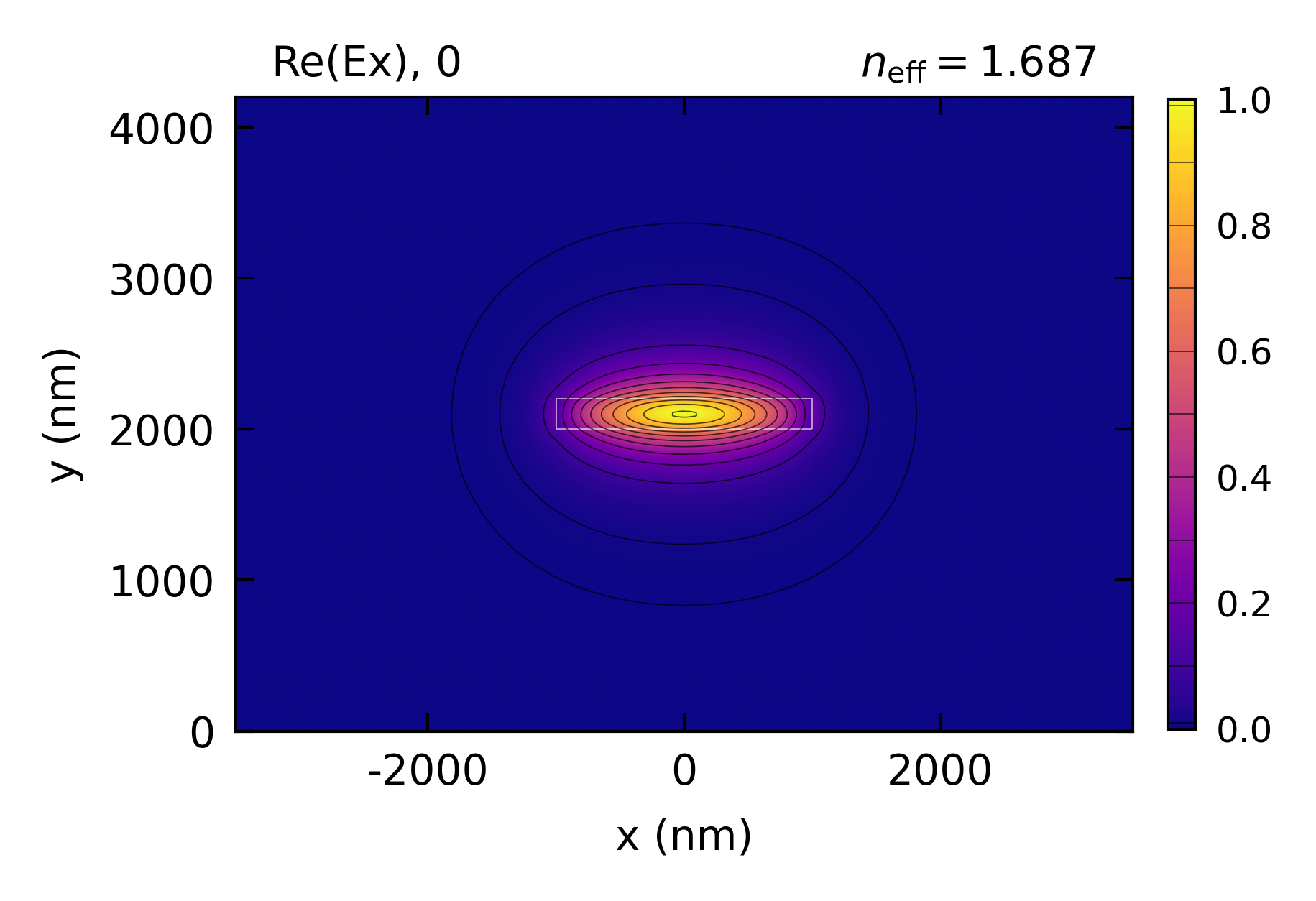
## Plot the guided mode of the finest FEM mesh
em.plot(component='Ex', file_name='straight_FEM', file_type='png')

## The reference is the finest FEM mesh, cross-checked against the Richardson
## extrapolation of the folded FDM's 10 and 5 nm results (second order: error ~ h^2)
reference, ng_reference = rows[-1][3], rows[-1][4]
fdm_10, fdm_5 = [r for r in rows if r[1] == 'TE'][-2:]
richardson = fdm_5[3] + (fdm_5[3] - fdm_10[3])/3
ng_richardson = fdm_5[4] + (fdm_5[4] - fdm_10[4])/3

## Print each solve's errors against the reference
print(f'\n{"solver":7s}{"walls":6s}{"mesh":>13s}{"n_eff":>11s}{"error":>10s}{"n_g":>10s}{"error":>10s}{"time (s)":>10s}')
for solver, walls, mesh, n_eff, n_g, elapsed in rows:
    print(f'{solver:7s}{walls:6s}{mesh:>13s}{n_eff:>11.6f}{n_eff - reference:>10.1e}{n_g:>10.5f}{n_g - ng_reference:>10.1e}{elapsed:>10.1f}')

print()
print(f'{"reference n_eff, FEM 6/wl, 50 nm:":36s}{reference:.7f}')
print(f'{"Richardson n_eff, FDM 10 and 5 nm:":36s}{richardson:.7f}')
print(f'{"difference:":36s}{richardson - reference:.1e}')
print(f'{"reference n_g, FEM 6/wl, 50 nm:":36s}{ng_reference:.6f}')
print(f'{"Richardson n_g, FDM 10 and 5 nm:":36s}{ng_richardson:.6f}')
print(f'{"difference:":36s}{ng_richardson - ng_reference:.1e}')

## Plot the effective index and group index errors against solve time
fig, axes = plt.subplots(1, 2, figsize=(10, 4))
for solver, walls, marker, label in (('FDM', '00', 'o', 'FDM'), ('FDM', 'TE', 's', "FDM, 'TE' fold"), ('FEM', '00', '^', 'FEM')):
    picked = [r for r in rows[:-1] if r[:2] == (solver, walls)]
    times = [r[5] for r in picked]
    axes[0].loglog(times, [abs(r[3] - reference) for r in picked], marker=marker, label=label)
    axes[1].loglog(times, [abs(r[4] - ng_reference) for r in picked], marker=marker, label=label)
axes[0].set_ylabel('|n_eff error|')
axes[1].set_ylabel('|n_g error|')
for ax in axes:
    ax.set_xlabel('solve time (s)')
    ax.grid(True, which='both', alpha=0.3)
axes[0].legend()
fig.tight_layout()
fig.savefig('straight_convergence.png', dpi=300)

em.close()
Console output:
EMode3D 1.0.7 - email
Meshing completed in 0.0 sec
Solving modes completed in 0.4 sec
Meshing completed in 0.0 sec
Solving modes completed in 1.6 sec
Meshing completed in 0.1 sec
Solving modes completed in 2.6 sec
Meshing completed in 0.2 sec
Solving modes completed in 11.4 sec
Meshing completed in 0.0 sec
Solving modes completed in 0.1 sec
Meshing completed in 0.0 sec
Solving modes completed in 0.3 sec
Meshing completed in 0.0 sec
Solving modes completed in 0.4 sec
Meshing completed in 0.1 sec
Solving modes completed in 2.0 sec
Meshing completed in 1.2 sec
Solving modes completed in 9.8 sec
Meshing completed in 0.0 sec
Solving modes completed in 0.2 sec
Meshing completed in 0.0 sec
Solving modes completed in 0.5 sec
Meshing completed in 0.0 sec
Solving modes completed in 0.7 sec
Meshing completed in 0.0 sec
Solving modes completed in 1.1 sec
Meshing completed in 0.0 sec
Solving modes completed in 1.5 sec
Meshing completed in 0.1 sec
Solving modes completed in 3.3 sec

solver walls          mesh      n_eff     error       n_g     error  time (s)
FDM    00            50 nm   1.684334  -3.1e-03   1.98882  -9.1e-03       0.4
FDM    00            25 nm   1.686675  -7.8e-04   1.99561  -2.3e-03       1.7
FDM    00            20 nm   1.686956  -5.0e-04   1.99643  -1.5e-03       2.8
FDM    00            10 nm   1.687330  -1.2e-04   1.99753  -3.5e-04      12.0
FDM    TE            50 nm   1.684334  -3.1e-03   1.98882  -9.1e-03       0.1
FDM    TE            25 nm   1.686675  -7.8e-04   1.99561  -2.3e-03       0.3
FDM    TE            20 nm   1.686956  -5.0e-04   1.99643  -1.5e-03       0.5
FDM    TE            10 nm   1.687330  -1.2e-04   1.99753  -3.5e-04       2.1
FDM    TE             5 nm   1.687424  -3.0e-05   1.99780  -7.8e-05      11.4
FEM    00     1/wl, 100 nm   1.687431  -2.3e-05   1.99778  -9.8e-05       1.0
FEM    00      1/wl, 50 nm   1.687445  -8.7e-06   1.99787  -8.6e-06       1.3
FEM    00      2/wl, 50 nm   1.687446  -8.1e-06   1.99787  -1.2e-05       1.5
FEM    00      3/wl, 50 nm   1.687449  -4.8e-06   1.99787  -1.2e-05       2.0
FEM    00      4/wl, 50 nm   1.687452  -2.2e-06   1.99787  -6.4e-06       2.6
FEM    00      6/wl, 50 nm   1.687454   0.0e+00   1.99788   0.0e+00       4.8

reference n_eff, FEM 6/wl, 50 nm:   1.6874538
Richardson n_eff, FDM 10 and 5 nm:  1.6874548
difference:                         1.0e-06
reference n_g, FEM 6/wl, 50 nm:     1.997880
Richardson n_g, FDM 10 and 5 nm:    1.997894
difference:                         1.4e-05
Exited EMode
Figures: